
Listen to this article
Estimated 6 minutes
The audio version of this article is generated by AI-based technology. Mispronunciations can occur. We are working with our partners to continually review and improve the results.
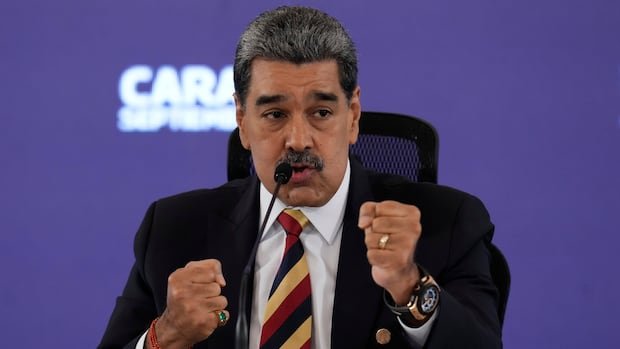
The capture of Venezuelan President Nicolás Maduro and his wife, Cilia Flores, has raised questions about the legality of a foreign government arresting a sovereign country’s leader at a time when the United States has been attempting to broker peace agreements around the world.
Experts in international law have suggested such actions could violate the terms of the Charter of the United Nations unless conducted in self-defence or with a resolution from the United Nations Security Council.
So how has U.S. President Donald Trump’s administration justified its country’s actions?
The main justification Trump officials have given so far is by explaining the capture as a criminal justice operation.
During a news conference on Saturday, Secretary of State Marco Rubio and Dan Caine, chairman of the U.S. Joint Chiefs of Staff, cast the military raid that captured Maduro and his wife as an action carried out on behalf of the U.S. Justice Department. Caine said the operation was made “at the request of the Justice Department.”
Rubio, as he responded to a question about whether Congress had been notified, said the U.S. raid to get the couple was “basically a law enforcement function,” adding that it was an instance in which the “Department of War supported the Department of Justice.” He called Maduro “a fugitive of American justice with a $50 million reward” over his head.
A newly unsealed Justice Department indictment accuses Maduro of running a “corrupt, illegitimate government” fuelled by an extensive drug-trafficking operation that flooded the U.S. with thousands of tons of cocaine.
The arrest of Maduro and Flores in a stunning military operation early Saturday in Venezuela has set the stage for a major test for U.S. prosecutors as they seek to secure a conviction in a Manhattan courtroom against the longtime leader of the oil-rich South American nation.
Attorney General Pam Bondi said in a post on social media platform X that Maduro and his wife “will soon face the full wrath of American justice on American soil in American courts.”
Here’s a look at the accusations against Maduro and the charges he faces.

Former Chilean ambassador to China Jorge Heine says a ‘certain threshold has been crossed’ after the U.S. struck several locations across Venezuela and apprehended the country’s president, Nicolás Maduro. He discusses the capture and the role of oil in American attacks on Venezuela.
Maduro faces drug and weapons charges
Maduro is charged alongside his wife, his son and three others. He is indicted on four counts: narco-terrorism conspiracy, cocaine importation conspiracy, possession of machine-guns and destructive devices, and conspiracy to possess machine-guns and destructive devices.
He’s facing the same charges as in an earlier indictment brought against him in Manhattan federal court in 2020, during the first Trump presidency. The new indictment unsealed on Saturday, which adds charges against Maduro’s wife, was filed under seal in the Southern District of New York just before Christmas.
Maduro allowed ‘cocaine-fueled corruption to flourish’
The indictment accuses Maduro of partnering with “some of the most violent and prolific drug traffickers and narco-terrorists in the world” to allow for the shipment of thousands of tons of cocaine into the U.S.
Authorities allege powerful and violent drug-trafficking organizations, such as the Sinaloa cartel and Tren de Aragua gang, worked directly with the Venezuelan government and then sent profits to high-ranking officials who helped and protected them in exchange.
But a U.S. intelligence assessment published in April, which drew on input from the 18 agencies that comprise the intelligence community, found no co-ordination between Tren de Aragua and the Venezuelan government.
Maduro allowed “cocaine-fuelled corruption to flourish for his own benefit, for the benefit of members of his ruling regime, and for the benefit of his family members,” the indictment alleges.

U.S. authorities allege that Maduro and his family “provided law enforcement cover and logistical support” to cartels moving drugs throughout the region, resulting in as much as 250 tons of cocaine trafficked through Venezuela annually by 2020, according to the indictment.
Drugs were moved on go-fast vessels, fishing boats and container ships or on planes from clandestine airstrips, the indictment says.
“This cycle of narcotics-based corruption lines the pockets of Venezuelan officials and their families while also benefiting violent narco-terrorists who operate with impunity on Venezuelan soil and who help produce, protect, and transport tons of cocaine to the United States,” the indictment says.
Read the Maduro criminal indictment:
Allegations of bribes, orders of kidnappings, murders
The U.S. accuses Maduro and Flores of ordering kidnappings, beatings and murders “against those who owed them drug money or otherwise undermined their drug trafficking operation.” That includes the killing of a local drug boss in Caracas, according to the indictment.
Maduro’s wife is also accused of accepting hundreds of thousands of dollars in bribes in 2007 to arrange a meeting between “a large-scale drug trafficker” and the director of Venezuela’s National Anti-Drug Office.

In a corrupt deal, the drug trafficker then agreed to pay a monthly bribe to the director of the anti-drug office, as well as about $100,000 US ($137,400 Cdn) for each cocaine-carrying flight “to ensure the flight’s safe passage.” Some of that money then went to Maduro’s wife, the indictment alleges.
Nephews of Maduro’s wife were heard during recorded meetings with confidential U.S. government sources in 2015 agreeing to send “multi-hundred-kilogram cocaine shipments” from Maduro’s “presidential hanger” at a Venezuelan airport.
The nephews explained during the recorded meetings “that they were at ‘war’ with the United States,” the indictment alleges. They were both sentenced in 2017 to 18 years in prison for conspiring to send tons of cocaine into the U.S. but were released in 2022 as part of a prisoner swap in exchange for seven imprisoned Americans.
Source link