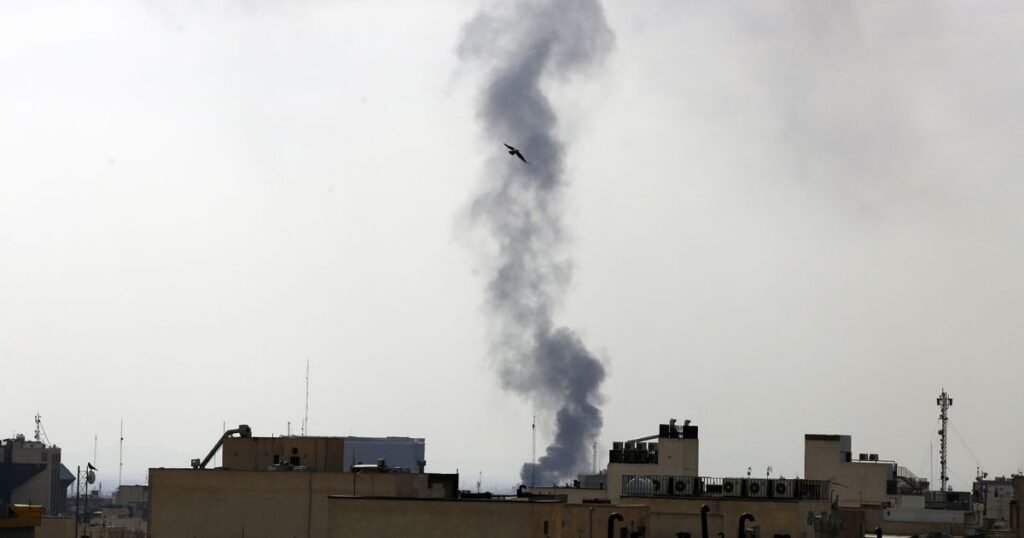
A radiation sterilisation plant in Isfahan province, central Iran, has been ‘severely damaged’ in a US-Israeli attack

Smoke rises from various locations in Tehran, Iran, on Saturday(Image: Anadolu via Getty Images)
An Iranian radiation sterilisation plant has been “severely damaged” in a US-Israeli attack.
The gamma irradiation facility in Isfahan province, central Iran, was struck in an air and missile attack by Israel and the US on Saturday, Iranian state media said. The centre sustained “severe damage”, but no radiation contamination has been detected in the surrounding environment so far, according to local reports.
Iran has a declared nuclear facility at Isfahan, which the Bulletin of the Atomic Scientists described as a “vast nuclear technology complex” and one of the most important sites in the country’s nuclear programme.
As the US and Israel carried out strikes across Iran on Monday, President Donald Trump repeated his claim that Tehran was seeking to rebuild its nuclear programme, even after US and Israeli attacks last June had in his words “obliterated” three key nuclear facilities.
Ensure our latest headlines always appear at the top of your Google Search by making us a Preferred Source. Click here to activate or add us as your Preferred Source in your Google search settings.
The Bulletin of the Atomic Scientists wrote in a report during Israel’s 12-day war on Iran: “The [Isfahan] site operates three small research reactors, and a fourth is planned to be built. In addition, the site includes a central chemical laboratory, a uranium conversion plant that converts uranium into uranium hexafluoride to be used in centrifuges for enrichment, as well as a reactor fuel manufacturing plant, and a nuclear waste storage facility.
“The site also includes a facility to convert uranium hexafluoride into triuranium octoxide (also known as “yellowcake”) and produce fuel plates to be used for experiments in the Tehran Research Reactor.”
Gamma rays – typically from a cobalt-60 source – can be used to sterilise medical products, disinfect food, kill bacteria and pests, modify materials, and simulate high-radiation environments for testing materials in military and nuclear technology, according to a 2021 US Department of Energy report on gamma irradiation facilities.
It comes after satellite images of Iran’s Natanz nuclear facility taken on Monday showed several damaged buildings, along with additional damage across the facility’s complex.
Vantor, an imaging company based in Colorado and formerly known as Maxar Technologies, released images that it said showed fresh damage to buildings housing personnel and to vehicle entrances to the underground fuel enrichment complex.
Earlier on Tuesday, the United Nations’ nuclear watchdog said the Natanz enrichment site sustained “some recent damage” following the US-Israeli attack on Iran.
The International Atomic Energy Agency (IAEA) said there was “no radiological consequence expected”.
Iran has four declared nuclear enrichment facilities – Natanz (including the FEP and PFEP), Fordow (FFEP) and the Isfahan complex.
The IAEA said last week in a confidential report, seen by The Associated Press, that due to lack of access it “cannot provide any information on the current size, composition or whereabouts of the stockpile of enriched uranium in Iran”.
Source link