
⚠️ THREE KEY TAKEAWAYS
(1): A 34,000-gallon methyl methacrylate tank at GKN Aerospace in Garden Grove, California is rising in temperature at approximately one degree Fahrenheit per hour. Based on available data, the tank could reach critical failure thresholds as early as late this week — and first responders have exhausted conventional options to stop it.
(2): California Governor Gavin Newsom, who has spent billions of taxpayer dollars on sweeping climate and environmental policy, faces serious accountability questions for presiding over a state regulatory framework that allowed a volatile, malfunctioning chemical tank, to sit inside a populated residential and commercial district — with no emergency contingency plan in place when the system failed at the worst possible moment.
(3): Homeowners and businesses displaced by the 50,000-person evacuation zone need to act immediately. Standard renters, homeowners, and commercial policies may not automatically cover displacement costs, business interruption losses, long-term contamination remediation, or the economic fallout from a chemical explosion. Every affected party should be on the phone with their insurance carrier today — not tomorrow.
THE CLOCK IS TICKING — AND RIGHT NOW, NOBODY CAN STOP IT
By Samuel López | USA Herald | May 24, 2026
GARDEN GROVE, CALIFORNIA — There is a bomb sitting in the middle of a Southern California community, and the fuse has already been lit.
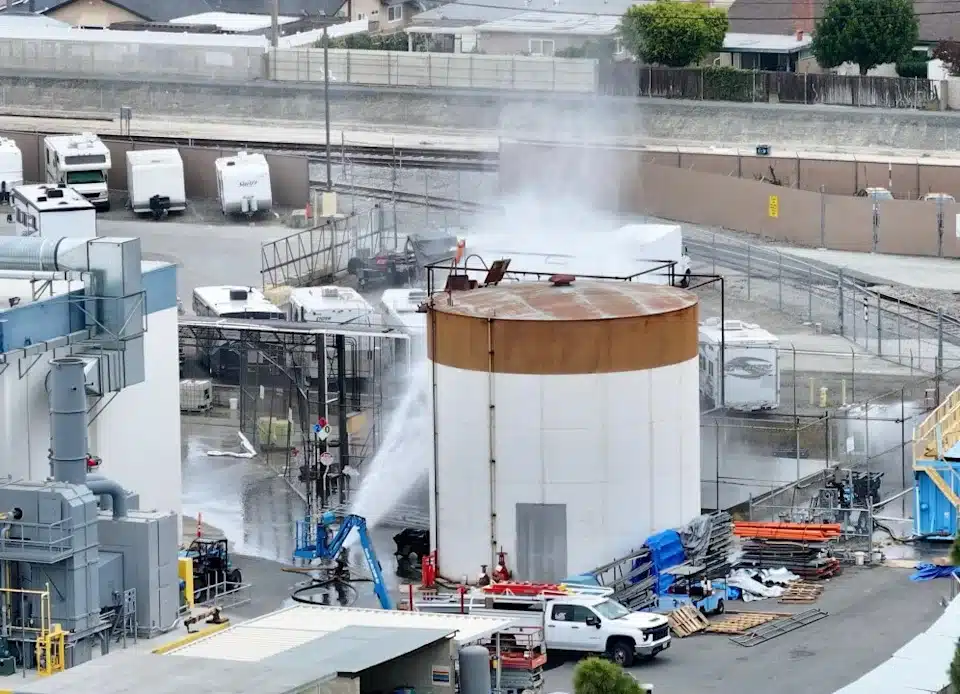
It is not a device planted by a terrorist. It is not the product of warfare or sabotage. It is a 34,000-gallon industrial storage tank at the GKN Aerospace facility at 12122 Western Avenue in Garden Grove, California, and it contains approximately 7,000 gallons of methyl methacrylate — a volatile, highly flammable chemical used to manufacture acrylic plastics. The tank has been heating up since Thursday, May 21, 2026. Its internal safety valves have seized. The chemical inside is polymerizing and generating its own heat. And as of this report, the best minds in American emergency chemical response have been unable to stop it.
The Orange County Fire Authority has stated with blunt clarity what the two remaining outcomes are: either the tank cracks and spills thousands of gallons of toxic chemical into the surrounding parking lot and neighborhood, or it enters what scientists call thermal runaway and detonates, sending a shockwave and a toxic chemical plume across one of the most densely populated corridors in Southern California.
This is not a drill. This is not a simulation. This is a real-time catastrophe unfolding in a community of families, businesses, and schools — and the USA Herald is giving you the facts, the data, the science, and the accountability that every American in this region deserves right now.
THE TEMPERATURE DATA: WHAT THE NUMBERS TELL US — AND WHEN THIS TANK COULD BLOW
Before Thursday morning, the tank temperature at the GKN Aerospace facility was operating at its normal baseline of approximately 72 degrees Fahrenheit. That was the last moment of normalcy. What happened next was the beginning of what officials are now calling one of the most serious industrial chemical emergencies in the history of Orange County.
By late Thursday, May 21, the temperature had already begun climbing. By the time a response crew was able to physically read the internal temperature gauge on the overheating tank on the night of Friday, May 22, the reading was confirmed at 90 degrees Fahrenheit — a rise of nearly 18 degrees from the pre-incident baseline in less than 24 hours. By Saturday, May 23, that number had climbed further to approximately 100 degrees Fahrenheit.
Orange County Fire Authority confirmed that the temperature inside the tank has been rising at a rate of approximately one degree Fahrenheit per hour since Thursday morning.
Here is where that data becomes terrifying.
At a sustained rate of one degree per hour — and the USA Herald must emphasize this is a conservative, linear projection, not accounting for the acceleration that accompanies thermal runaway — the tank would need to climb an additional 150 degrees Fahrenheit from its Saturday reading of 100 degrees to reach the 250-degree Fahrenheit threshold that officials have identified as the outer limit before catastrophic structural failure becomes inevitable. At one degree per hour, that is 150 hours from Saturday — which places the outer window of linear projection at approximately late Thursday to Friday, May 28-30.
But here is the critical scientific reality that every resident, business owner, and public official needs to understand: thermal runaway is not linear. It is exponential.
Methyl methacrylate is a self-reactive chemical. Its polymerization reaction generates its own heat, and as that heat builds, the reaction accelerates. As the reaction accelerates, it produces more heat. The chemical is essentially feeding its own fire from the inside out. This means the one-degree-per-hour rate observed in early measurements is almost certainly not the rate that will govern the final hours before failure. The ascent will steepen. The curve will bend sharply upward. What appears to be a week away on a linear chart could arrive in days — or hours — under exponential conditions.
USC Associate Professor of Chemistry Elias Picazo has explained that the valves likely failed because the MMA had already begun polymerizing inside them, hardening the chemical into a plug that rendered the cooling mechanisms useless. That is not a sign of a tank that is slowing down. That is a sign of a chemical reaction that is already well underway and advancing.
The USA Herald’s analytical assessment, based on the confirmed temperature trajectory and the known properties of methyl methacrylate under thermal runaway conditions, suggests that the critical danger window is not a week away. It may arrive well before the end of this week — potentially within 48 to 72 hours of this publication. Every hour of delay in finding a solution is an hour closer to a detonation that emergency officials have already acknowledged they cannot rule out.
WHAT FIREFIGHTERS AND FIRST RESPONDERS ARE UP AGAINST
Let’s talk about what the men and women of the Orange County Fire Authority, Garden Grove Police, and every first responder deployed to this scene are facing — because it is unlike almost anything in the modern history of American emergency response.
OCFA Chief Craig Covey, a fire service veteran of 32 years, said publicly that this is the worst situation he has encountered in his career. That statement alone should tell every American reading this report exactly how serious this moment is.
The firefighters on the ground at 12122 Western Avenue are battling an enemy they cannot physically reach. The tank that is in crisis — Tank Number One — cannot be safely approached for manual intervention. The chemical has already polymerized inside the valve housing, meaning the ports through which cooling agents or neutralizing compounds would normally be introduced are physically blocked, which likely caused the main valve to “Gum up” as reported previously by USA Herald. Crews have been spraying water on the exterior of the tank to cool it from the outside, but this approach is fighting the heat from one side while the chemical reaction generates heat from within.
If the tank spills, first responders will confront approximately 6,000 to 7,000 gallons of methyl methacrylate flooding a parking lot and potentially flowing toward storm drains and waterways. Crews have already deployed sandbag containment barriers to prevent runoff from entering the water system — a secondary catastrophe that would compound the primary one. But MMA vapor is heavier than air. It sinks. It settles into low-lying areas, channels, and enclosed spaces. A liquid spill on a warm Southern California day will generate vapor plumes that could drift into surrounding neighborhoods without warning, turning the evacuation zone into an invisible gas chamber for anyone who reenters prematurely.
If the tank explodes — which officials have stated is the more likely outcome — the blast radius will extend well beyond the immediate GKN Aerospace facility. Orange County Health Officer Dr. Regina Chinsio-Kwong has already publicly mapped potential blast and impact zones across the surrounding area. An explosion would not only destroy structures within the immediate blast radius; it would aerosolize thousands of gallons of MMA into a vapor cloud capable of causing severe respiratory damage, chemical burns to the eyes and skin, nausea, dizziness, and what Dr. Chinsio-Kwong described as severe respiratory issues for anyone caught in the plume.
And then there is the chain-reaction risk. Authorities have confirmed that three tanks are affected at the GKN site. Tank Number Two, which contains the same chemical, has been treated with a neutralizing agent and appears structurally sound — for now. But an explosion of Tank Number One could compromise Tank Number Two and whatever additional fuel or chemical storage exists in the surrounding blast radius, triggering a cascading catastrophic failure that no emergency plan currently on paper could fully contain.
Police facing this scene must manage an evacuation zone of approximately 50,000 displaced people while simultaneously maintaining perimeters that are constantly pressured by residents desperate to return home and business owners watching their livelihoods dissolve hour by hour. Officers must also prepare for the possibility that, in an explosion scenario, the perimeter itself becomes a casualty zone.
This is not a scenario from a disaster movie. This is Garden Grove, California. Sunday, May 24, 2026.
THE HUMAN COST: 50,000 PEOPLE WITHOUT HOMES, AND A COMMUNITY IN CRISIS
Fifty thousand human beings have been displaced from their homes and businesses because of decisions — or the catastrophic absence of decisions — made long before Thursday afternoon.
Think about that number. Fifty thousand people woke up in someone else’s home, or a shelter, or a hotel room, or the backseat of a car this weekend. Children who should be in school are displaced. Elderly residents who depend on routine and stability have been uprooted. Business owners are watching their inventory expire, their refrigerators go dark, their customer relationships erode, and their revenue evaporate while they wait for an all-clear that nobody can give them a timeline for.
Schools in the area closed on Friday. Commerce along one of Orange County’s busiest commercial corridors ground to a halt. The economic losses accumulating inside the evacuation zone are not hypothetical — they are happening right now, dollar by dollar, hour by hour, and the meter is still running.
And when the immediate crisis is over — whether it ends in a spill, an explosion, or some as-yet-undiscovered third option — the cleanup and contamination aftermath will extend the suffering for months, possibly years. Methyl methacrylate is classified as a hazardous substance. A major spill would require professional hazmat remediation of the soil, the drainage system, and potentially nearby water sources. An explosion would scatter contaminated material across a wide radius, demanding forensic-level environmental cleanup that would render portions of the affected zone uninhabitable or commercially unusable for an extended period. Air quality monitoring will need to continue long after the event. Soil and groundwater testing will follow. And the liability litigation — a class-action lawsuit has already been filed against GKN Aerospace — is only beginning.
GAVIN NEWSOM: WHERE WERE THE INSPECTORS?
Now let’s talk about accountability. And that conversation starts at the top.
California Governor Gavin Newsom declared a state of emergency in Orange County on Saturday, May 23, pledging to mobilize every available state resource in support of local responders. The declaration was necessary. The press release was polished. But a state of emergency declaration issued after a crisis has already metastasized into a 50,000-person displacement event is not a policy achievement. It is damage control.
Governor Newsom has built his national political profile on the assertion that California leads the nation in environmental stewardship, climate responsibility, and corporate accountability. His administration has committed billions of California taxpayer dollars to climate initiatives, green regulations, and environmental oversight programs designed, in theory, to protect communities from exactly the kind of industrial hazard now threatening Garden Grove.
So here is the question that the USA Herald is putting directly to Governor Newsom and his administration: where were the inspectors?
The valve at the center of this crisis — the safety valve on Tank Number One at the GKN Aerospace facility — failed, according to expert analysis, because methyl methacrylate had polymerized inside the valve housing, gumming up the mechanism until the valve was effectively non-functional. Investigators will likely examine whether that is the signature of prolonged neglect, or something else.
GKN Aerospace is not a small, under-the-radar operation. It is a major aerospace manufacturing firm that builds engines and landing gear for both commercial and military aircraft. Its facility at 12122 Western Avenue sits embedded in a densely populated area that includes residential neighborhoods, schools, and businesses. The chemical it stores — methyl methacrylate — is classified as a highly volatile flammable liquid with well-documented hazard properties. The EPA regulates exposure limits. OSHA governs workplace safety thresholds. California’s own environmental and industrial safety agencies maintain regulatory authority over facilities like this one.
And yet, by every available indication, a safety valve critical to preventing exactly the kind of thermal emergency now threatening an entire community is at the heart of this catastrophe, because it failed, precisely at the moment it was needed most.
The California Department of Toxic Substances Control, Cal/OSHA, and every relevant state regulatory body with jurisdiction over this facility will need to answer for how this happened. But the governor sets the tone and the priorities for the regulatory apparatus beneath him. When the political energy of an administration is consumed by headline-generating climate policies, when the focus is on solar subsidies and zero-emission mandates, the unglamorous but absolutely essential work of inspecting industrial safety valves and tanks in aerospace facilities embedded in residential communities can fall through the cracks.
The Orange County District Attorney’s office has already launched a probe into the causes of this emergency. That investigation needs to follow the chain of oversight — or the chain of its absence — all the way up.
The people of Garden Grove deserve better than a state of emergency declaration issued after the event has already begun.
THE INSURANCE CRISIS INSIDE THE CRISIS
Right now, tens of thousands of homeowners, renters, and business owners in the Garden Grove evacuation zone are facing a financial emergency on top of a physical one — and most of them have no idea how exposed they actually are.
Here is what every displaced person needs to understand, and here is why you need to have this conversation with your insurance carrier today.
Standard homeowners insurance policies typically cover damage caused by fire and explosion. If this tank explodes and the blast damages your home, your homeowners policy may cover structural repairs. But coverage is rarely automatic, and exclusions matter enormously. Some policies contain exclusions for chemical contamination, environmental hazards, or events originating from industrial facilities. If your home is in a contamination zone rather than a direct blast zone, your insurer may argue that the damage is environmental in nature — and exclude it from coverage.
Renters face a different landscape. Renters insurance typically covers personal property loss and may cover additional living expenses if your unit becomes uninhabitable. But coverage limits on additional living expenses are often modest, and the costs of a prolonged displacement — hotel stays, meals, storage for belongings — can exceed those limits quickly, particularly if the evacuation stretches for weeks.
Business owners face the most complex exposure of all. Commercial property insurance may cover physical damage to your business premises. But the losses accumulating right now — lost revenue, spoiled inventory, broken customer relationships, staff disruptions — fall under business interruption coverage, and that coverage has its own rules. Many business interruption policies require a covered physical loss at your location as a triggering event. If your business is undamaged but simply inaccessible due to the evacuation order, some insurers may dispute whether the trigger has been met.
Here is what you need to do right now, whether you are a homeowner, renter, or business owner. Contact your insurance carrier or broker immediately and document the date and time of that call. File a claim or a notice of potential claim today — do not wait until the crisis resolves. Ask specifically about civil authority coverage, which some commercial policies include and which covers losses when a government authority restricts access to your property. Ask about additional living expense coverage and its limits. Begin documenting every loss, every expense, and every day of displacement in writing. Photograph your property before any cleanup or damage remediation begins.
The class-action lawsuit already filed against GKN Aerospace is an additional avenue of potential recovery. If the company is found liable for negligent maintenance of the tank and its safety systems, displaced residents and businesses may be entitled to compensation through civil litigation. But litigation moves slowly. Insurance claims, if handled correctly, can provide relief in weeks rather than years.
Do not assume you are covered. Do not assume you are not covered. Find out now.
WHAT HAPPENS WHEN THE SMOKE CLEARS
The immediate crisis will end. It will end one way or another — through a solution that has not yet been discovered, through a contained spill, or through the explosion that officials are already planning for. But what comes after the immediate crisis is a story that will unfold for months and years.
The environmental contamination cleanup from a major methyl methacrylate spill or explosion will be a complex, expensive, and time-consuming operation. Soil in the affected area will need to be tested and potentially removed. Groundwater monitoring will be required for an extended period. Any chemical that entered storm drains during the incident will need to be traced and remediated. Air quality testing will continue long after the visible event has concluded. The buildings within the immediate blast radius of an explosion will require structural assessment before anyone is permitted to reenter them.
The legal and financial reckoning will be extensive. GKN Aerospace will face not only the class-action lawsuit already filed but potentially regulatory penalties from state and federal agencies, civil claims from displaced residents and businesses, and the full scrutiny of an Orange County DA investigation into the cause of the malfunction. The company’s insurer will be assessing exposure across multiple categories of liability simultaneously.
The USA Herald will be monitoring the temperature data, the regulatory investigation, the legal proceedings, and the human impact of this crisis as it develops. We are not going anywhere. And neither are the questions.
Samuel López is an investigative reporter for the USA Herald covering law, public accountability, national security, and consumer protection. Follow the USA Herald on X: @RealUSAHerald
Stay ahead of the story. Subscribe to the USA Herald newsletter for exclusive investigative reporting and insider-level coverage at usaherald.com.
© 2026 USA Herald. All rights reserved. This report is based on information available as of May 24, 2026. The temperature projections contained herein are analytical estimates based on publicly reported data and known chemical properties and should not be construed as definitive predictions. Readers should follow guidance from official Orange County and California emergency management authorities.
Source link