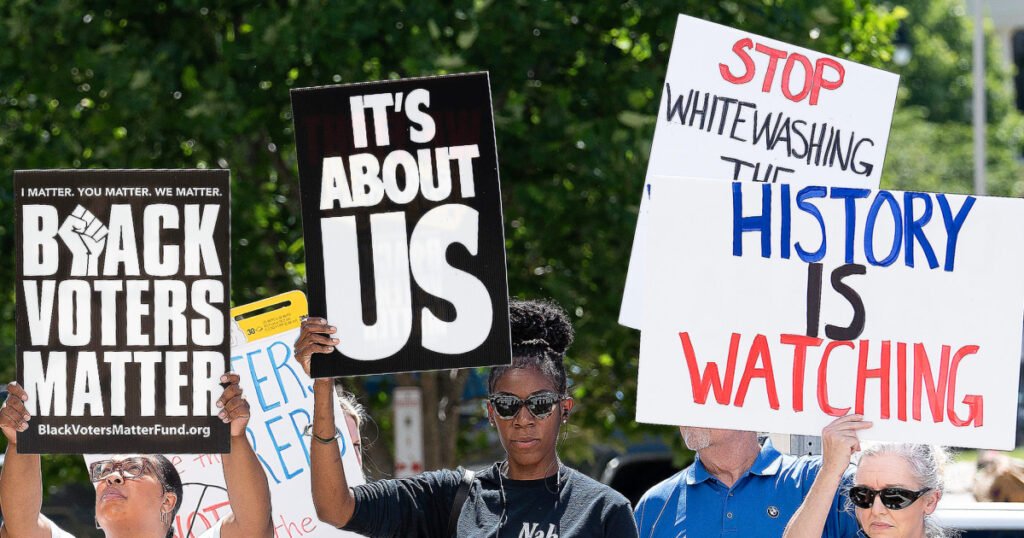
The Supreme Court on Tuesday allowed Alabama to use a congressional map that eliminates one of two majority-Black districts in the state in a win for Republicans.
Subscribe to read this story ad-free
Get unlimited access to ad-free articles and exclusive content.

The justices, split 6-3 on ideological lines with conservatives in the majority, granted an emergency request filed by Republican officials seeking to use the map, which was enacted in 2023 but has never been used.
In the unsigned three-page order, the court said the state is likely to ultimately prevail on its claim that the map was lawfully drawn.
In dissent, liberal Justice Sonia Sotomayor said the majority’s decision “disregards both democratic values and the rule of law.”
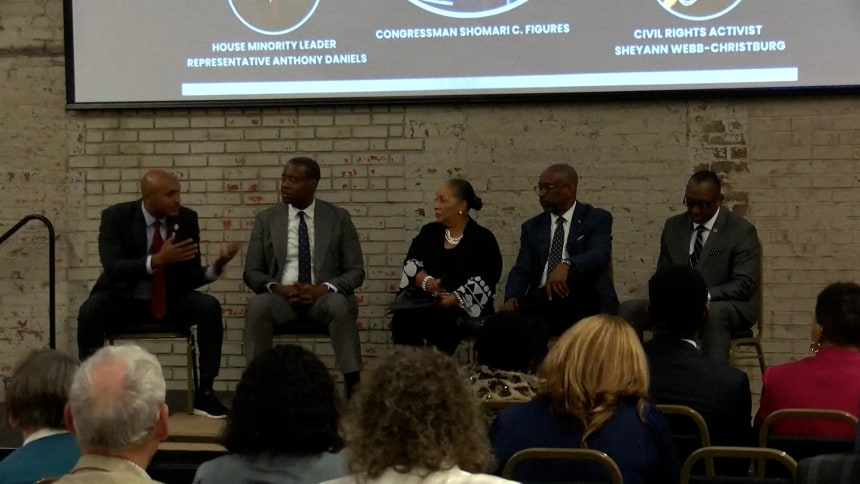
Under the redrawn map, Democratic Rep. Shomari Figures would be likely to lose out.
A lower court found that the map intentionally discriminated against Black voters in violation of the Constitution’s 14th Amendment. In an earlier ruling, the court had also found that the map violated the Voting Rights Act.
The intentional discrimination decision was based on the fact that the state drew the 2023 map with one majority-Black district even after the lower court suggested that there should be two after it found an earlier map violated the Voting Rights Act. That ruling rejecting Alabama’s 2021 map was upheld by the Supreme Court in 2023.
But the Supreme Court asked the lower court to take a new look at the case in light of its recent ruling in a case from Louisiana that weakened the Voting Rights Act, a law that previously placed sharp limits on states’ diluting the power of minority voters.
The three-judge panel on May 26 concluded for a second time that the map was unconstitutional.
In Tuesday’s order, the majority said the lower court did not sufficiently take into account its Louisiana ruling, which requires judges to largely defer to states’ partisan interests in drawing maps that benefit the majority party.
The majority also faulted the lower court for issuing a ruling so close to the election.
“Here, the District Court interposed itself into Alabama’s ongoing efforts to conduct its imminent 2026 congressional elections under maps that its elected representatives selected,” the court said. “Its view that conducting the elections under court-imposed maps would be more convenient for the State was not a valid justification for that intervention.”
Alabama’s attorney general praised the ruling.
“Tonight’s decision is a major victory for Alabama and for the principle of self-governance,” state Attorney General Steve Marshall said in a statement. “The United States Supreme Court confirmed what we always knew: that Alabama’s Congressional maps are constitutional and lawful under the Voting Rights Act.”
The decision is likely to add fuel to criticism that the Supreme Court itself acted too close to the midterm elections when it issued the Louisiana ruling, less than three weeks before that state planned to hold its congressional primaries.
Sotomayor made exactly that point in her dissent, saying the court could have used its authority “to fix the mess it has created” but instead chose to “deepen it further.”
The court could have allowed an “orderly election” using the existing map, but instead chose a “chaotic election, held under a never-before-used congressional map that intentionally discriminates against Black Alabamians,” she added.
The ruling also “corrodes the rule of law by rewarding Alabama’s gamesmanship and outright defiance of court orders,” Sotomayor said.
The state’s primaries were originally due to take place May 19, but officials pushed them back while they raced to respond to the Supreme Court’s Louisiana ruling and restore their preferred map. The primaries are now set to take place Aug. 11.
The NAACP blasted Tuesday’s order.
“The Supreme Court continues to unleash chaos in our democratic process, and with this latest action, gives Alabama approval to use a congressional map that had previously been found to be intentionally discriminatory,” Kristen Clarke, the group’s general counsel, said in a statement.
“This is a Court that is stripping Black voters of power and voice at a speed that would put Jim Crow jurists to shame. Our message to communities remains the same — the best way to express dissent is by showing up at the ballot box this election season,” she added.
The last year has seen an unprecedented wave of fast-track redistricting that was kicked off by President Donald Trump’s demand that Texas redraw its map to favor Republicans. Usually, maps are drawn only once a decade following the U.S. census.
Republicans have a narrow majority in the U.S. House and are seeking to minimize their losses in the midterm elections in November.
The redistricting situation was made more complicated by the Supreme Court ruling in the Louisiana case, which sparked a frenzy among mostly Southern states to redraw maps to eliminate majority-Black districts held by Democrats.
Source link