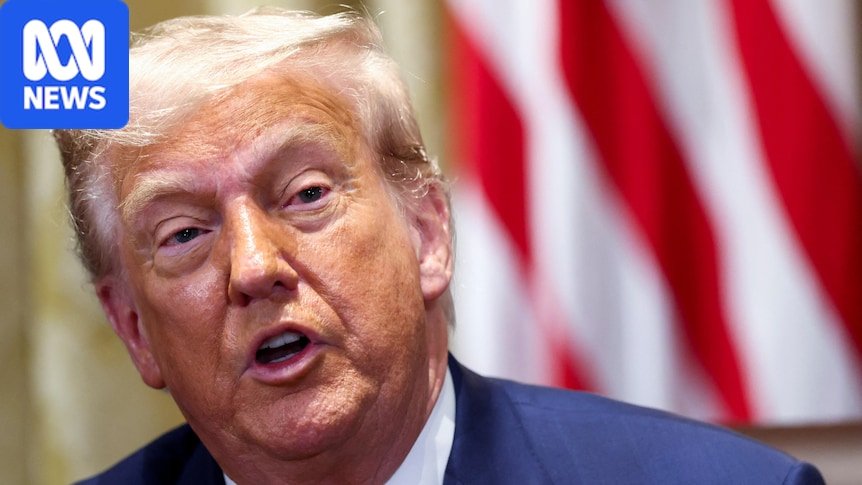
The Trump administration has placed a 12.5 per cent tariff on Australian exports to the US.
The new levy has replaced a temporary 10 per cent tariff that expired at the same time the new tariff took effect.
Dozens of other countries have also been hit with new tariffs, which were first proposed last month after a US trade investigation into forced labour in international supply chains.
Some of those countries, including the UK, are only subject to a smaller 10 per cent tariff. The US says those nations are taking stronger action against forced labour — a claim Australia disputes.
“Australia is a country that deals with the issue of modern slavery seriously,” Trade Minister Don Farrell said.
“This imposition of higher tariffs on Australia is unjustified and we will continue to lobby the United States trade representative to remove all tariffs on Australian goods.”
Deputy Prime Minister Richard Marles said the decision made “no sense” and the Australian government was arguing “very forcefully” against it.
The tariffs took effect from 12:01am Friday, local time (2:01pm Friday, AEST).
The Trump administration argues the US is doing its part to combat forced labour but other countries are not, putting American companies at a competitive disadvantage.
However, many analysts say US President Donald Trump is simply trying to replace the tariffs that were invalidated by the US Supreme Court earlier this year, and the forced labour investigation is merely a pretext.
“As expected, the administration is well on its way toward ensuring that, through a patchwork of investigations, the United States will ultimately have tariffs similar to those [previous tariffs],” Council on Foreign Relations president Michael Froman recently wrote.
Loading…
Democrats have been quick to criticise the move. Congresswoman Linda Sanchez said Mr Trump was “trying to make an end-run around the Supreme Court and Congress to reimpose his illegal tariffs”.
“If he was serious [about combating forced labour], he would not be applying the same tariff rate to China, one of the worst forced labor abusers in the world, as he does to countries like Australia,” she wrote on X.
“Then again, unlike China, Australia doesn’t manufacture any Trump corporation products.“
The new tariffs are not being placed on top of existing tariffs on imports like metals and car parts, which are levied under a different section of trade law.
And many products that were exempt from the previous tariff are also exempt from the new one. That includes some food products which were granted exemptions as the Trump administration responded to public anger over rising living costs.
“Our largest exports to the United States continue to get into the United States tariff-free,” Mr Farrell said, pointing to beef, gold and copper.
“I think we’re going to continue to have a high volume of trade into the United States, but we’re always looking for new markets.”
US ignores Australia’s request
The Australian government had asked the US not to go ahead with the proposed tariff.
In a formal submission earlier this month, Australia reiterated its opposition to Mr Trump’s tariffs, which have created a sore point in a traditionally strong bilateral friendship.
The submission argued Australia has some of the world’s strongest legislation to tackle forced labour. It questioned why countries with similar measures, like the UK, would be subject to smaller tariffs.
It also pointed to the US’s annual Trafficking in Persons Report, which assesses a country’s efforts to prevent forced labour and has consistently given Australia the best possible rating.
Australian law requires large companies to submit annual “modern slavery statements” to show how they have addressed the risk of forced labour in their supply chains.
The submission also argued Australia had been working constructively with the US on trade issues, pointing to recently relaxed restrictions on American beef imports, and the critical minerals framework deal signed at the White House last year.
“The strength of this economic relationship … means that Australia should not be subject to the proposed action, or any tariff measure whatsoever,” it said.
The Business Council of Australia also lodged a submission urging against the tariff.
Today, it said the US was “penalising Australian businesses for no justifiable reason”.
“This decision will make it harder for Australian businesses to compete and sell their products into the US market, hurting investment and our jobs,” the council said.
Probe followed Trump’s anger over court ruling
The US began formally investigating forced labour in supply chains in March, shortly after the Supreme Court struck down many of Mr Trump’s tariffs in February.
At the time, Mr Trump and his trade officials said such investigations were among the mechanisms they would use to replace the invalidated tariffs, and that the new tariffs would be “potentially higher”.
However, the US now argues the new tariffs are about correcting human rights abuses and distortional trade practices.
“President Trump recognizes that decades of moral suasion have not eradicated forced labor from global supply chains,” US trade ambassador Jamieson Greer said in a statement today.
“The United States has had a forced labor import ban for nearly a century, and rigorously enforces it; it’s well past time for our trading partners to do the same.”
The Trump administration says it is broadly using tariffs to protect domestic manufacturers from foreign competitors and incentivise them to employ Americans.
Mr Trump has also repeatedly used the threat of tariffs as a negotiating tool in dealings with foreign leaders.
Before the Supreme Court decision, Australian products had been subject to a 10 per cent tariff under a system announced by Mr Trump last April.
After the Supreme Court decision, Mr Trump placed a temporary 10 per cent “global tariff” on most imports from abroad, which meant the tariff on Australian products was effectively unchanged.
But the temporary tariff could not legally stay in place without a vote in Congress.
Loading…
Source link