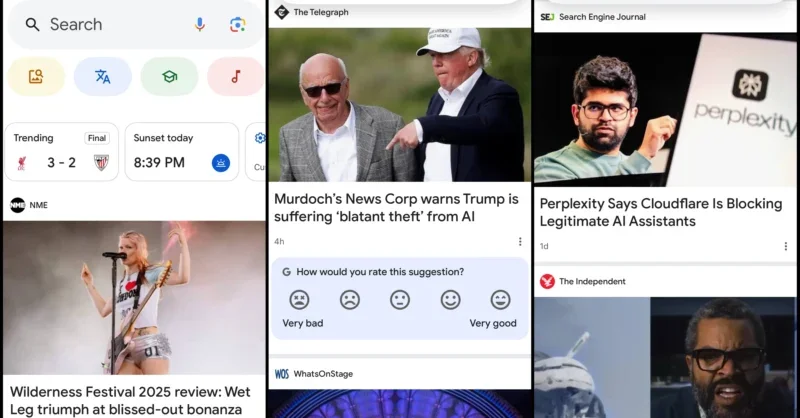

Breaking news on Google Discover is making up almost all growth in search referrals for major US news publishers, according to new data.
Organic search traffic to 64 publishers has dropped 42% since AI Overviews launched in 2024.
The Google Search Console data was shared by Define Media Group, which manages SEO and audience development for major publishers in the US with clients listed on its website including Conde Nast, Bloomberg, CNN, Hearst, Los Angeles Times, Business Insider, The New York Times and USA Today. (This does not mean these publishers are included in the analysis.)
Define said its clients received a combined average of 1.7 billion organic search clicks for the five quarters to Q1 2024.
But from Q2 2024, when Google’s AI Overviews were first introduced in the US, the portfolio saw a 16% drop in search traffic which has never recovered. There was a further drop after the expansion of AI Overviews in May 2025.

Define zoomed in on its top 15 national and local brands and saw that breaking news was the only content type that saw growth.
Traffic to breaking news was up 103% across both Google Search and Discover since November 2024.
Most of this growth was from Google Discover, which was up 168% compared to November 2024. Web search traffic to breaking news stories was up 2% while Google News referrals were down 7%.
The most significant growth in Discover traffic was after the December 2025 Google core update which negatively impacted the visibility in core search for many major publishers.
A subsequent core update to Discover in February took referrals down again slightly but traffic from the feed to breaking news stories remains more than double where it was before December.
The February Discover update was designed to reduce the amount of “sensational content and clickbait”, and show users more “locally relevant content” and “in-depth, original, and timely content from websites with expertise in a given area”.

Define noted that for the first time since it has been tracking this type of data, Discover and Search are sending an equal amount of traffic to the group of 64 publishers.
Among the core group of 15 publishers, organic search traffic to evergreen content such as how-tos, explainers and product reviews was down 40% since November 2024 as this type of content is most exposed to AI Overviews.
[Read more: Google ‘exploring updates’ to let publishers opt out of AI Overviews]
Traffic to website landing pages (such as topic pages) at the 15 publishers in the analysis was down 48% since November 2024 while homepage traffic was down 19%.
Publishers at Press Gazette’s Media Strategy Network USA event in New York last week were mixed on whether Google Zero (the point at which publishers receive zero clickthroughs from the search platform) will happen – but all agreed they needed to prepare for this scenario.
For many publishers part of that equation has been moving away from evergreen content traditionally designed to harness search traffic, focusing instead on creating original news and analysis that is unique to their brand.
Chartbeat: Smaller sites being hit harder than larger sites
Also published this week, Chartbeat data showed that overall traffic to publishers within the data platform’s network declined 6% year on year in 2025, which CEO John Saroff described as “well within normal fluctuation”.
Although search referrals were down (Google Search falling 34% in the year to December 2025 and Discover down 16%), “internal traffic and dark social are rising to fill the gap,” Saroff said. Dark social (via emails and messaging tools like Whatsapp) was up from 7% of total traffic to 10% in January 2026. Internal has grown from 38% in 2024 to about 41%.
But smaller sites are being hit much harder, Chartbeat found. Sites with between 1,000 and 10,000 daily average page views saw search traffic down 60% in 2025.
Medium sites (daily page views of 10,000 to 100,000) were down 47% in search while large sites (more than 100,000 page views) were down 22%.
Saroff said this means “brand recognition and direct audience relationships are becoming essential survival tools. If you’re a smaller publisher, doubling down on SEO won’t save you building loyalty, newsletters, and niche authority will.”
Chatbeat also said that although ChatGPT referrals to publishers have increased by more than 200% in the past year, chatbots still account for less than 1% of total page views.
News publishers make up 14% of AI citations
Separate research from PR platform Buzzstream found that news publications are making up 14% of all citations in Google’s AI products (including AI Overviews, AI Mode and Gemini) and OpenAI’s ChatGPT.
The analysis looked at four million citations given in response to 3,600 prompts using XOFU, an AI citation monitoring tool from Citation Labs, in the week from 27 January.
The top news publications to be cited were Yahoo, Forbes and Seeking Alpha.
Yahoo was the top result for both brand awareness and evaluative/decision-making type queries, followed by Tech Target and Seeking Alpha respectively. Meanwhile Forbes, followed by CNBC and Yahoo, was top for informational queries.
Buzzstream’s analysis also found that around 75% of sites blocking OpenAI or Google AI bots still appeared in AI citations.
And 29% of news citations in ChatGPT came from publishers that have partnered with OpenAI.
Google has done far fewer AI deals although less than 1% of citations in AI Overviews, AI Mode and Gemini came from the Associated Press, which last year agreed to provide a “feed of real-time information to help further enhance the usefulness of results displayed in the Gemini app”.
Email pged@pressgazette.co.uk to point out mistakes, provide story tips or send in a letter for publication on our “Letters Page” blog
Source link