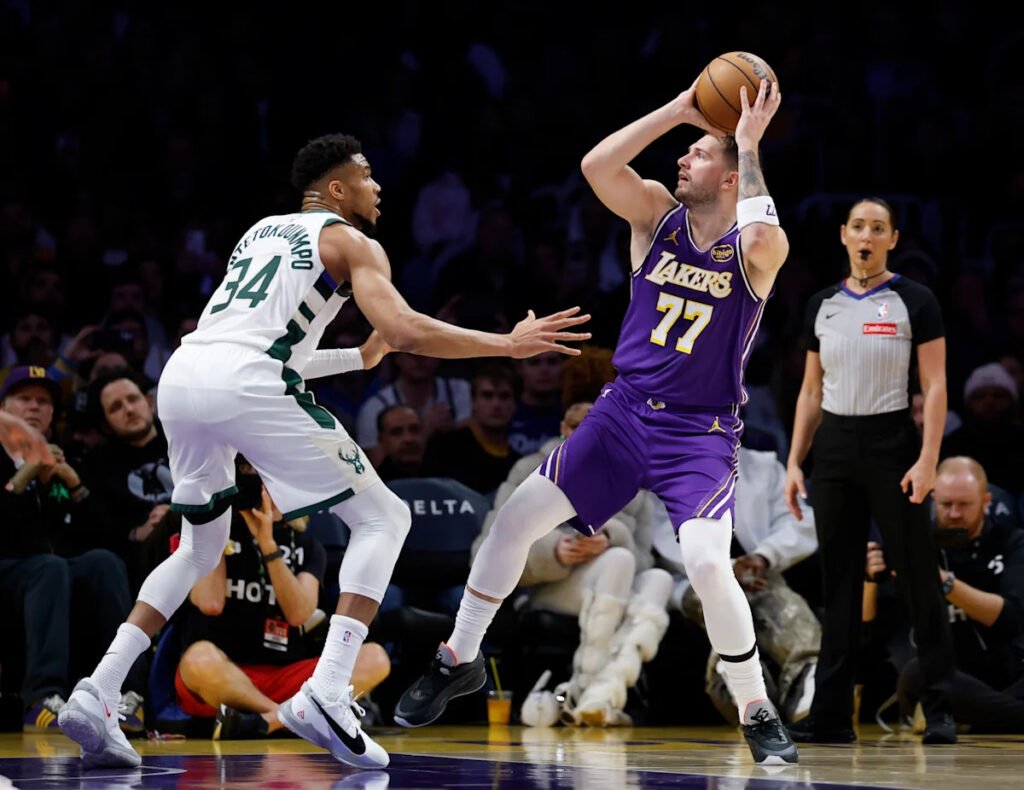
Dončić and Antetokounmpo also headlined the first and second fan voting returns the league released.
Advertisement
Fans are responsible for 50% of the vote that selects each conference’s five starters. NBA players (25%) and a media panel (25%) account for the other slices of the vote.
This year’s All-Star Game will be played in Inglewood, California, at the Los Angeles Clippers’ Intuit Dome on Feb. 15. For the first time in the exhibition’s soon-to-be-75-year history, there are no positional requirements for lineups.
Notably absent from the list of NBA All-Star starters this year is LeBron James, whose 22-year streak as an All-Star starter has officially come to an end.
With that in mind, here are the starting fives for the Eastern and Western Conference:
Advertisement
Eastern Conference
- Giannis Antetokounmpo, F, Milwaukee Bucks
Jalen Brunson, G, New York Knicks
Cade Cunningham, G, Detroit Pistons
Tyrese Maxey, G, Philadelphia 76ers
Jaylen Brown, F, Boston Celtics
Western Conference
Nikola Jokić, C, Denver Nuggets
Luka Dončić, F, Los Angeles Lakers
Shai Gilgeous-Alexander, G, Oklahoma City Thunder
Stephen Curry, G, Golden State Warriors
Victor Wembanyama, F, San Antonio Spurs
Here’s how the voting was split across players, fans and media:
Wembanyama and Minnesota Timberwolves guard Anthony Edwards tied for the final West starting slot with a 5.75 weighted score. Wembanyama won the tiebreaker because he had 1,965,462 fan votes to Edwards’ 1,960,957.
So what’s next?
The conferences’ reserves will be selected by NBA head coaches on Feb. 1. Each conference will have seven reserves.
Previously, those seven reserves were made up of two backcourt players and three frontcourt players, plus two wild cards. Now they, too, will be picked without regard to position.
Advertisement
What you need to know about the All-Star Game’s new format
This year’s All-Star Game will feature three teams: Two will consist of players from the United States, and a third will be made up of players from the rest of the world.
The process for assigning players to the two U.S. teams will be determined at a later date, according to the league.
Ideally, of the 24 total All-Star roster spots, voting will fill 16 of them with U.S. players and eight of them with international players, who, if necessary, can be American players with ties to other countries.
But if those numbers aren’t reached organically, NBA commissioner Adam Silver will pick additional All-Stars so that each group hits its mark. In that scenario, at least one team would end up with more than eight players.
Advertisement
For instance, if there’s a 15-9 split among U.S. and international All-Stars, one extra U.S. player would get the commissioner’s nod, meaning that there’d be 25 total All-Stars and the international team would have nine players instead of eight.
In terms of the game itself, there will still technically be four 12-minute quarters, although each will be its own game, as each of the three teams will play twice during round-robin action. The fourth “quarter” will pit the two teams with the best records — point differential will be the post-round-robin tiebreaker if all three teams have 1-1 records — to decide a champion.
Source link