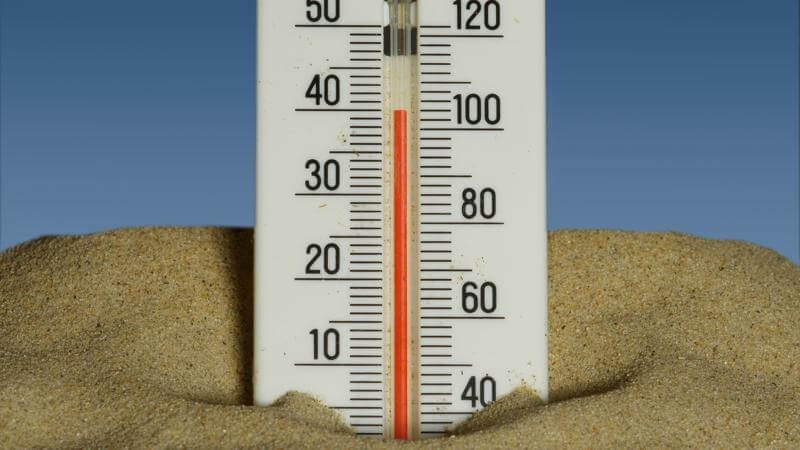
The Western United States are getting a little taste of what climate change apocalypse feels like this week, as an unprecedented heat wave has descended on an entire half of the country, toppling records for the hottest March temperatures ever recorded in states such as California, Arizona, Colorado, Wyoming, South Dakota and Idaho. In fact, this week has already been so hot in some of these locales that a few of them have already registered temperatures above the current records for April as well. Temperatures in these places have spiked 20 to 40 degrees above the typical monthly average for this time of year. So, who’s ready for a summer where California burns to a crisp and Arizona melts into a puddle of liquid rock?
On Friday at the end of last week, Yuma, Arizona registered an official temperature of 109 degrees. That figure sets a new record for the hottest single temperature ever recorded in the United States in the month of March, according to weather records from the National Weather Service. Since then, however, the record has already potentially been eclipsed a few more times–temperatures of 110 degrees and 112 degrees were recorded near Martinez Lake, Arizona last week, but haven’t been officially verified. Regardless, it is clear that records are being smashed left and right. Phoenix hit 102 and 105, smashing its March record and already tying its April record. Flagstaff hit 84 degrees, which was 11 degrees more than its previous March record. Cities like Palm Springs, Burbank, Fresno, Denver, Las Vegas and Salt Lake City have all beaten their all-time March heat records within the last week, and some of them are likewise challenging April records already.
So, yesterday the US set a new March temperature record of 110 degrees, beating the old record by two degrees.
Today the US set a new March temperature record of 112 degrees, beating the new record by two degrees and the old one by four degrees.
— Bill McKibben (@billmckibben.bsky.social) Mar 20, 2026 at 9:15 PM
The extreme temperatures have been caused by what is known as a “heat dome,” a stagnant and slow-moving bubble of unusually hot air that has been fed by the ways our planet has been irrevocably altered by human-powered climate change. Such heat domes are becoming more frequent and longer-lasting on a yearly basis, and despite the wishes of a sizeable chunk of the U.S. population to believe that human activity isn’t the root cause, there’s no scenario where one can choose to believe this without having their head stuck in a hole in the (scorching) sand. Last week, climate scientists at the non-profit World Weather Attribution concluded as much in a new report, finding that this kind of heat wave would be “virtually impossible for this time of year in a world without human-induced climate change.” We are the authors of this sweltering chapter of human history.
This kind of heat isn’t just some sort of theoretical annoyance; it’s an almost deadly certainty that will have a direct toll on human lives, with effects only amplified, according to that same World Weather Attribution report, by the fact that the heat is arriving in a time of the year when it isn’t expected. Extreme heat is cited as the most deadly form of extreme weather in the United States, with the country regularly setting new records for heat deaths. The rest of the world is much the same, with Europe being especially vulnerable to deaths linked to soaring temperatures, and an increasingly high percentage of those deaths being directly attributable to climate change.
Virtually every major Colorado weather station is breaking its hottest March temperature on record right now. Absurd.
#COwx
— Chris Bianchi (@bianchiweather.bsky.social) Mar 21, 2026 at 6:38 PM
Our planet is being altered in front of our eyes by these changes. The oceans continue to get hotter, killing off key species and causing mass relocations, which has devastating and labyrinthine effects on food webs that are beyond our ability to plan for or anticipate. Staple crops are becoming harder and harder to grow in America, which could upend the expectations of what typically constitutes the plant-based side of the American diet–and that’s before Donald Trump’s war in Iran blocked the Strait of Hormuz and created a global fertilizer crisis that will further reduce food availability. We are so deeply unprepared for the complexities of the butterfly effect here that this type of spiraling climate change can kill us in so many ways you’d never even consider–you’re even more likely to die via mushroom poisoning right now than you would have been before we screwed up the planet’s climate.
Case in point: This kind of encroaching heat we’re seeing in the last week in the Western U.S. has already radically transformed the entire concept of “fire season” in relatively dry states such as California, changing when large-scale fires can generally be expected to break out and how severe they’re quickly able to become. Researchers at UCLA, examining decades of “fire occurrence data” to determine the typical onset of fire season, published a study in Science Advances in which they concluded the following:
“The typical onset of summer fire season, which is in May or June in many regions, has shifted earlier by at least one month in most of the state since the 1990s, and by about 2½ months in some regions, including the northern mountains. Of that, we found that human-caused climate change was responsible for advancing the season between six and 46 days earlier across most of the state from 1992 to 2020.”
And again, this is data from before the state was setting new March heat records. We are venturing into uncharted territory at this point. The only certainty is that there will be struggle, and there will be loss, and that Congressional Republicans will continue to ignore the plight of the people actually living in these places until they’ve all been rendered uninhabitable. Bring on July and August.
Source link