Published on
March 18, 2026

Image generated with Ai
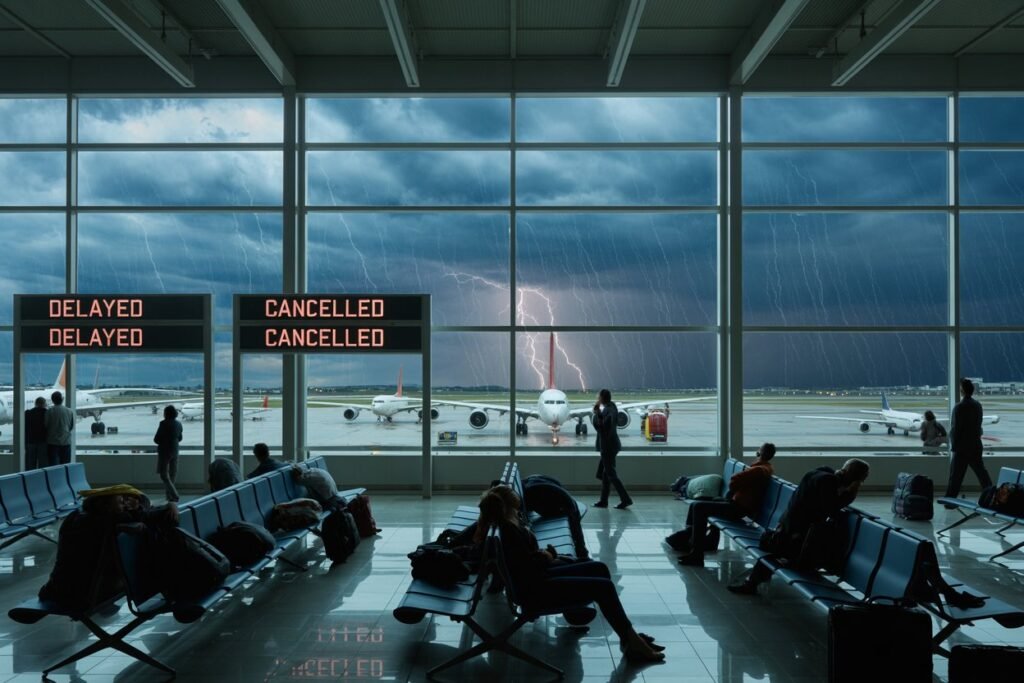
– In airports across the US this week, it has felt less like the start of a carefree spring break and more like a marathon of uncertainty, as families clutch boarding passes, students huddle around charging points and weary business travellers stare at departure boards that keep turning red. What was supposed to be a simple hop to the beach, a long‑planned reunion or a crucial client meeting has, for many, turned into an emotional roller‑coaster of hopeful refreshes on airline apps, sudden cancellations and hurried calls home to explain that they will not be arriving when they promised.
Federal data and airline tracking figures cited in national reports show that after a wave of disruption on Monday, airlines scrubbed more than 1,000 additional flights within, into or out of the US on Tuesday and delayed roughly 4,000 to 4,500 more as the storm’s effects lingered. The Washington‑based Federal Aviation Administration (FAA) repeatedly issued traffic management programs and ground delay advisories, warning that weather and volume constraints were forcing slower arrival and departure rates at key hubs.
Sites that monitor operations in real time highlighted that some of the heaviest hits were at Chicago O’Hare International Airport, Atlanta’s Hartsfield‑Jackson, New York’s LaGuardia and other major connecting airports, where even a single thunderstorm band or snow squall can ripple across the entire country’s network. Airlines tried to ease the pain by offering change‑fee waivers on many affected routes, but with planes already full of spring break travellers, same‑day alternatives were often limited.
What the storms did: snow, wind and severe weather across regions
According to the National Weather Service (NWS), the system first pounded parts of the Midwest with heavy, wet snow and strong winds, prompting winter storm warnings and hazardous travel advisories across stretches of the Great Lakes and surrounding states. As the low‑pressure system pushed east, forecasters issued severe thunderstorm and high‑wind alerts for sections of the Ohio Valley, Mid‑Atlantic and Northeast, cautioning that damaging gusts and isolated tornadoes were possible.
These evolving threats forced air‑traffic managers and airlines to constantly reset their plans: de‑icing queues in snowy airports slowed morning departures, while lightning near ramps and strong crosswinds halted operations in other cities later in the day. Officials stressed that the decision to hold or cancel flights is ultimately about safety, even when it means painful knock‑on delays for travellers far from the storm’s centre.
Spring break squeeze: storms collide with peak leisure travel
What makes this disruption especially brutal is its timing: the storm has smashed directly into one of the busiest spring break travel windows of the year, when flights are already running near capacity and airports are crowded with infrequent flyers. Many families booked these trips months ago, stacking non‑refundable hotels and theme‑park tickets on top of airfare, and now find themselves stuck in terminals, juggling work emails and restless children on borrowed airport Wi‑Fi.
Advertisement
Advertisement
Travel industry outlets report that beach and city destinations popular with college students are feeling the impact too, as connecting flights through Chicago, Atlanta or East Coast hubs are delayed or cancelled, forcing last‑minute reroutes and overnight stays. With aircraft and crews out of position, airlines warn that it will take time to fully rebuild schedules, meaning some passengers will face disruptions even after the worst of the weather clears.
TSA pressure: longer lines and fewer staff amid shutdown strain
Compounding the frustration, national coverage notes that the Transportation Security Administration is still dealing with staff shortages linked to the ongoing partial federal government shutdown, leading to sporadic security‑checkpoint closures and longer wait times in certain airports. Live updates from federal dashboards and airport advisories show that some passengers have waited well over an hour at screening during peak periods, especially when weather‑driven reschedulings push more travellers into the same time window.
Officials urge passengers to arrive early, enrol in trusted‑traveller programmes where possible and keep carry‑on rules in mind to avoid extra delays at checkpoints. Even so, the combination of storm disruptions and staffing constraints has turned some terminals into scenes of frayed tempers and exhaustion, with travellers stretched across the floor trying to sleep while announcements echo in the background.
Government guidance: what agencies say travellers should do now
The FAA and NWS both emphasise that travellers should monitor airline notifications closely, check airport status tools before leaving home and stay on top of evolving weather alerts, rather than relying on a single forecast from days earlier. Federal agencies recommend that passengers build extra buffer time into their itineraries, keep medications and essentials in carry‑ons and be prepared for mid‑journey changes, including diversions and unplanned overnight stops.
Consumer advice from transportation departments and travel‑safety organisations also stresses the value of flexible tickets and travel insurance in volatile weather seasons, especially for trips tied to milestones such as weddings, cruises or international connections. For drivers who decide to skip the airport entirely, state transport agencies urge caution on snow‑covered or water‑logged highways, where visibility and traction can deteriorate quickly.
Human side of the storm: travellers trying to stay hopeful in long lines
Inside the terminals, the numbers and advisories translate into small, human moments: a student on the phone explaining to parents that the long‑imagined first solo trip may start a day late, a grandparent nervously watching a boarding gate clock, and airline agents fielding a stream of anxious questions while trying to rebook as many people as possible. For now, passengers across Chicago, New York, Atlanta and dozens of other cities are learning to measure progress in small wins—a confirmed seat tomorrow, a hotel voucher finally issued, a text alert that their flight is merely delayed instead of cancelled—and hoping that as the storm system moves on, US air travel will slowly return to something that feels normal again.

Source link