The war in Ukraine provides a vivid example. The conflict over whether it should be an independent nation or a facet of greater Russia “goes back hundreds of years,” Cohen said. “It’s not going to end with the current conflict.
“It’s similar to the relationship between Quebec and Canada. Quebec is a distinct community, with a different language, which has periodically challenged its incorporation into the larger state. The same is true of Ukraine. A majority of Ukrainians believe they have the right to a state of their own. Putin and his people take a quite different view.”
The difference between the two situations, of course, is that Canada has found a way to keep Quebec in the fold, primarily through allowing the province to have considerable sovereignty over its own affairs (including the use of French as an official language). Cohen sees this sort of compromise — also found in the relationship between the United Kingdom and Scotland, and Spain and Catalonia — as the most promising way to avoid violence.
But it’s simply not happening in most potential trouble spots. The most dangerous of these is surely Taiwan, an island off the Chinese coast that has been independent from the mainland since the end of World War II. “From the point of view of the Chinese government, and probably the Chinese people, Taiwan belongs to China,” said Cohen, who sees the odds of China eventually using force to establish control as “very high.”
“The Chinese are increasingly bold in the waters around Taiwan,” he noted. “They’re gradually encircling the island in anticipation of an eventual embargo, in which ships could not enter or leave. It’s a clever, incremental strategy. At some point, my fear is Taiwan will feel it necessary to resist this by force. That’s when things could get ugly.”
Of course, things are already pretty ugly — not to mention chaotic — in the realm of international trade. Cohen said he has never witnessed anything like the current state of disorder in his lifetime. The closest analogy he can find is the period immediately after World War I which produced the infamous Smoot-Hawley Tariff Act of 1930.
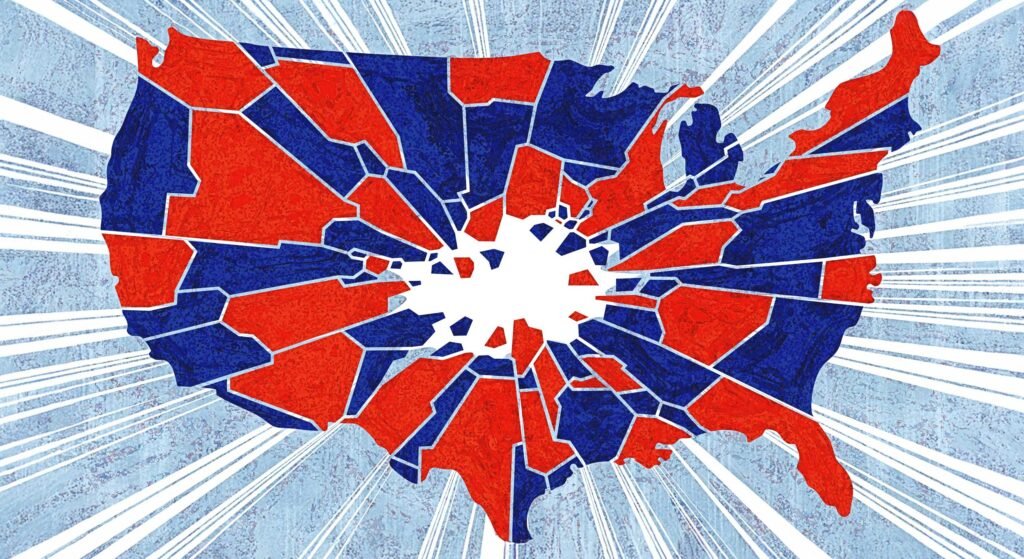
But as Cohen notes, much of human decision-making is driven by forces other than logic. In the case of the secession movements he documents in “Dream States,” the primary driver is usually a sense of identity — the impulse to rally behind the group you feel you belong to, and the insistence on its right to act independently.
“Identity can be a very powerful motivator,” he said. “That’s why I worry about the risk of civil war. When it comes to something as strong as a sense of community identity, rationalism falls by the wayside.”
Source link