WASHINGTON — Hanwha Defense USA (HDUSA) and autonomous maritime company Magnet Defense are teaming up to build medium unmanned surface vessels (MUSVs) and robotic shipyards, company executives told Breaking Defense.
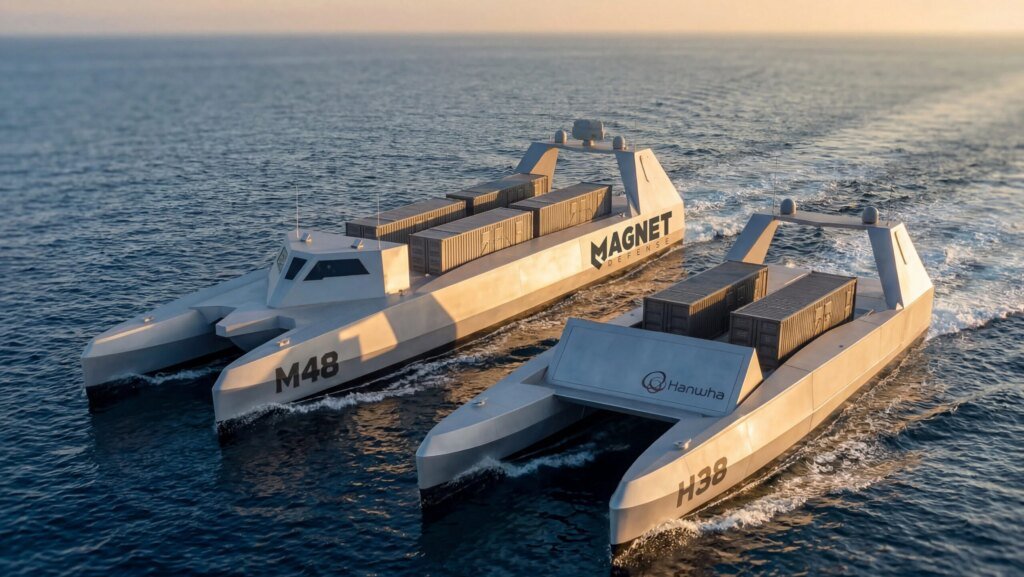
Both companies are signing a Memorandum of Understanding (MOU) at the Sea-Air-Space Exposition in National Harbor, Md., on Monday, based around crafting a 38-meter MUSV. The companies will also work on building AI-driven robotic shipyards, advanced AI software, and other projects under the MOU.
“Hanwha remains committed to fielding the most capable and lethal MUSVs to support American warfighters and other allies in times of conflict,” HDUSA CEO Michael Coulter said in a statement. “By partnering with Magnet Defense, Hanwha can utilize its manufacturing capacity and advanced robotics and pair these capabilities with Magnet Defense’s proven autonomy and technology.”
Magnet Defense, based out of Miami, already has a flagship MUSV known as the M48 that completed a 32,000-nautical mile trip from Miami to American Samoa and back in 2024, where it transited the Panama Canal and weathered Sea State 9 conditions. The M48 can support a variety of mission sets, including integrated air and missile defense, anti-surface and anti-submarine warfare, and search and rescue, according to a March press release from Magnet Defense.
The MOU focuses on producing a new MUSV, dubbed the H38, which seeks to build upon what Magnet Defense has already developed, according to Kevin Schoonover, HDUSA’s senior vice president for missiles.
The partnership comes as the Navy announced in March it was unveiling a new, MUSV marketplace in an attempt to acquire USVs quickly by focusing on production-ready, mission capable platforms already in the MUSV space to fulfill a host of operational needs.
“As the United States starts really focusing on MUSVs and weaponized MUSVs, we really wanted to start finding partnerships and collaborations with very disruptive companies — just like we are — and try to develop a new product that’s affordable, that opens up new doors,” Schoonover told Breaking Defense on Friday.
The MOU also will require the companies to establish AI-driven shipyards across the country that will rely heavily on automation to build these new systems, and augmented reality to quickly train up a human workforce to function as robot operators. These shipyards are expected to open the end of next year, CEO of Magnet Defense Marc Bell told Breaking Defense on Friday.
“Our plan is to build shipyards around the country to build different products,” Bell said. “Think of it as almost like a car assembly line, except the ship doesn’t move, so it gets built in place by robots. And the robots do all the cutting, they do all the welding, they do all the assembly without human interaction. Humans just run the robots from behind.”
The partnership also coincides with Chief of Naval Operations Adm. Daryl Caudle’s plans to develop a “containerized capability campaign” that seeks to deploy modularized payloads like drones or missiles quickly.
“We are designed for containers. That is the mission,” Bell said. “We’re listening to the demand signals from the Navy, and this is where they want to go.”
Source link