US president says although the pilots were rescued, Washington ‘must, of necessity, respond to this attack’.
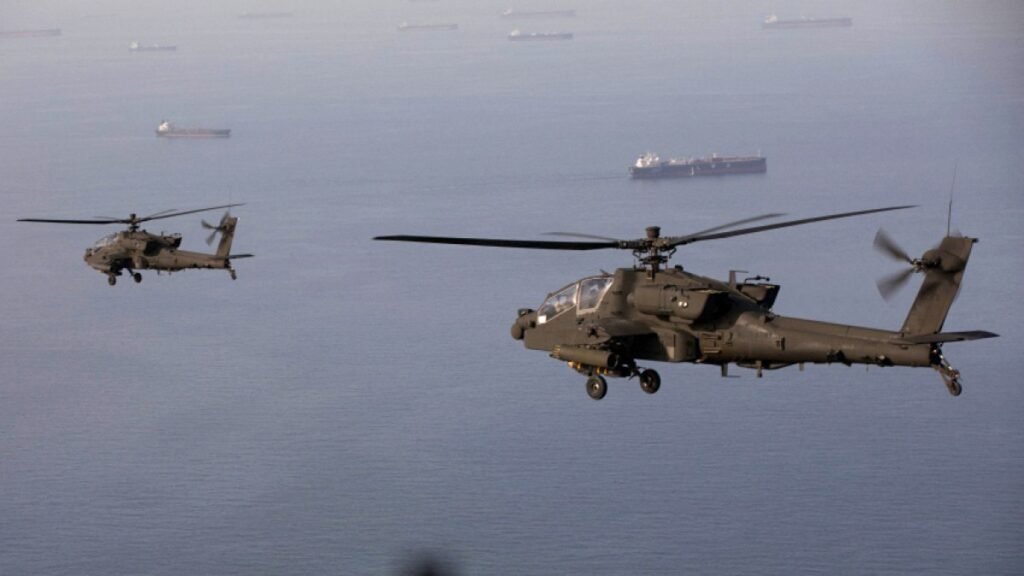
President Donald Trump has accused Iran of shooting down a United States military helicopter over the Strait of Hormuz, saying that he will respond to the attack.
“I have just been informed by our Great Military that last night the Iranians shot down one of our highly sophisticated Apache Helicopters while patrolling over the Strait of Hormuz,” Trump wrote in a social media post on Tuesday.
Recommended Stories
list of 3 itemsend of list
“There were two pilots involved, both are safe and uninjured. Nevertheless, the United States must, of necessity, respond to this attack.”
Trump’s latest threat risks rupturing an April 8 truce that paused the US-Israel war against Iran, though that agreement has already been pushed to the brink by repeated skirmishes across the region.
The Middle East-based Central Command (CENTCOM), which oversees US military operations in the region, had said earlier that the cause of the incident was under investigation.
“The Soldiers were safely rescued within approximately two hours and are in stable condition,” CENTCOM said.
Iran has not confirmed or denied downing the helicopter, but in an apparent response to Trump’s claim, Foreign Minister Abbas Araghchi called on US forces to withdraw from the region.
“The Strait of Hormuz is NOT international waters but shared between Iran and Oman, and located thousands of miles away from US shores. Maritime boundaries are crystal clear,” Araghchi said in a statement.
“Our Powerful Armed Forces are on constant alert for any violation of Iran’s airspace, land or waters. Foreign forces in proximity to our territory are at constant risk on account of their own human errors, plain accidents, or potentially being caught in crossfire.”
The latest escalation comes after the US military said that it disabled an Iranian oil tanker in the Gulf on Monday.
Fighting has also erupted between Iran and Israel over the past days. Iran fired missiles at Israel in response to its bombing of Beirut. Israel retaliated by carrying out strikes inside Iran, despite Trump’s calls for restraint.
Since the April truce came into effect, it has come under strain by repeated attacks and counter-attacks in the region.
Earlier this month, the US military carried out strikes against Iran’s Qeshm Island, to which Tehran responded with missile launches against a US base in Kuwait. A drone also hit Kuwait’s international airport, killing one person, but Iran has denied responsibility for that attack.
Trump has played down those previous instances of violence, stressing that a deal between Washington and Tehran remains close despite the tension.
A direct Iranian attack on US troops appears to be a step up the escalatory ladder.
Top officials in Tehran have repeatedly argued that the US naval siege on Iranian ports, as well as the ongoing Israeli attacks in Lebanon, constitute a violation of the April 8 ceasefire.
Minutes before Trump made his claim about the helicopter on Monday, Mohammad Bagher Ghalibaf, Iran’s parliament speaker and its chief negotiator, suggested that his country is not afraid to return to war.
“We prefer the language of diplomacy, but we speak other languages far more fluently. Break your commitments, and we’ll switch to what we speak best,” Ghalibaf wrote on the social media platform X.
“You ride the horse you saddled!”
Sina Azodi, the director of the Middle East studies programme at Georgetown University, said Iran is aware that the war is unpopular in the US.
He believes that Iran is trying to pressure Trump to finalise an agreement that would comprehensively end the conflict.
That pressure comes as Trump faces international scrutiny on multiple fronts. His country, for instance, is preparing to cohost the FIFA World Cup, which starts on Friday.
“The Iranians are trying to make it very clear that they’re not going to back down. They are willing to escalate with the Americans, and I think they’re putting as much pressure as they can on the American side to get a deal,” Azodi told Al Jazeera.
Source link