
Listen to this article
Estimated 5 minutes
The audio version of this article is generated by AI-based technology. Mispronunciations can occur. We are working with our partners to continually review and improve the results.
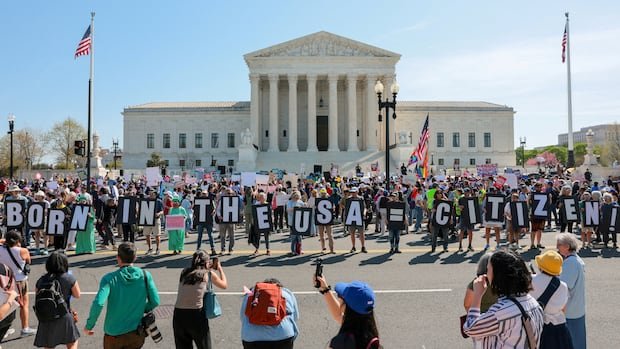
The U.S. Supreme Court on Tuesday ruled against Donald Trump’s executive order limiting birthright citizenship, in a highly anticipated decision that confirms a lower court finding.
The president’s order, not retroactive, would have denied citizenship to those born to parents who are in the U.S. without authorization, or whose presence is lawful but temporary, such those on a work or student visa.
The 6-3 ruling in the Trump v. Barbara case marked the second time this year that the court has invalidated a major Trump initiative, following its February decision to strike down his sweeping global tariffs. While Justice Brett Kavanaugh sided with the majority, he stressed that Congress could pass legislation to carve out exceptions to birthright citizenship.
The 14th Amendment, enacted in the 19th century and supported by subsequent legislation, has essentially guaranteed citizenship for babies born in the U.S., with only narrow exceptions such as the children of foreign diplomats or an enemy occupying force.
The challengers said the Supreme Court had already settled the question in the 1898 case United States v. Wong Kim Ark, which recognized that the citizenship granted under the 14th Amendment includes the children of foreign nationals.
“Not surprisingly, then, in the 128 years since, we have repeatedly understood the rule of Wong Kim Ark to guarantee citizenship to all children born in the United States and subject to its power. We see no reason to depart from that view today,” wrote Chief Justice John Roberts, who authored the opinion.
Going forward, critics of the order argued, it had the potential to impact, on average, a quarter of a million children born in the U.S. each year. In one of several so-called “friend of the court” briefs, a group of municipal and local officials argued that Trump’s order would create “stateless” children subject to stigma and discrimination, whose access to basic services and health care would be compromised.
Trump attended the U.S. government’s oral argument before the court on April 1, the first time a president has ever done so.
‘Dramatically revisionist view’
The legal challenge to Trump’s directive involved a class-action lawsuit filed in New Hampshire by parents and children whose citizenship was threatened by the executive order.
The provision at issue — the 14th Amendment’s “citizenship clause” — states: “All persons born or naturalized in the United States and subject to the jurisdiction thereof, are citizens of the United States and of the state wherein they reside.”
The administration asserted that the phrase “subject to the jurisdiction thereof” means that being born in the U.S. is not enough for citizenship.
Two Blocks from the White House32:48How far will the U.S. Supreme Court allow Trump to go?
Roberts said there was “scant evidence” to support the Trump administration’s “dramatically revisionist view.”
During the arguments, U.S. Solicitor General D. John Sauer, representing the administration, said the promise of citizenship for virtually any baby born on U.S. soil has spawned what he called a sprawling industry of “birth tourism.”
Sauer said that “uncounted thousands of foreigners from potentially hostile nations have flocked to give birth in the United States in recent decades,” to secure citizenship for their children. Asked to explain how serious the issue has become, Sauer primarily cited media reports and conceded that “no one knows for sure.”
The Center for Immigration Studies, which is in favour of restricting immigration, and the non-partisan Migration Policy Institute, have estimated that number could be somewhere around 20,000 to 25,000 births per year, about two to three per cent of all births in the U.S.
While many countries do not guarantee citizenship by birth, including Britain and Australia, the push from the Trump administration comes as it’s clamped down on legal immigration and denied nearly all asylum claims, aside from white applicants from South Africa, a country in which Blacks are overrepresented under the poverty line, following decades of racial segregation.
As well, the administration has undertaken an expansive deportation campaign compared to previous Democratic and Republican presidential administrations, with the Supreme Court last year in an unsigned order making it less challenging for the government to send deportees to countries not of their origin.
The Census Bureau has reported that U.S. population growth last year was at one of its lowest levels in recent memory, aside from the early stages of the COVID-19 pandemic, owing largely due to a historic decline in net international migration.
Read the Supreme Court’s ruling on birthright citizenship:
Source link