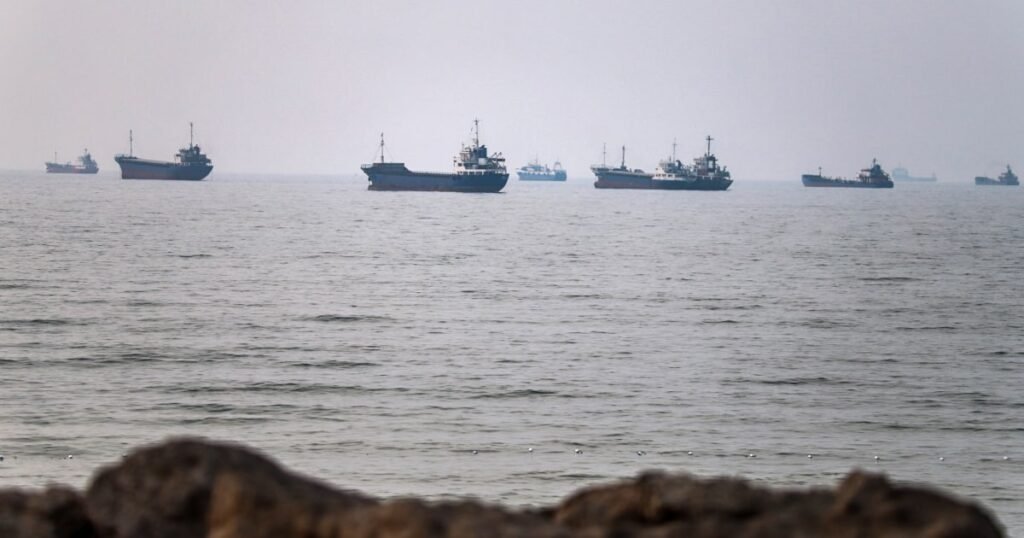
The United States Central Command (CENTCOM) says the US has completed a third round of strikes this week against Iran at the direction of US President Donald Trump in response to an attack on a civilian ship transiting the Strait of Hormuz.
The US carried out strikes on 140 Iranian military targets, including missile and drone sites, naval capabilities, ammunition stockpiles, communications networks and coastal surveillance facilities, it said.
“Iran made a poor choice. Now they pay,” US Secretary of Defense Pete Hegseth said on social media.
Iranian state media reported US strikes across its southern provinces, including Bushehr, Hormozgan, Khuzestan and Sistan and Baluchestan.
In response, Iran attacked multiple US bases in the region and said it closed the Strait of Hormuz, before CENTCOM said it was open and that US forces were positioned to ensure freedom of navigation.
Iran said it would consider targeting “additional enemy bases in the region” if it faced more attacks.
Iran’s main negotiator and speaker of parliament, Mohammad Bagher Ghalibaf, said that “the era of one-sided deals is over”.
“We told you: keep your word or pay the price. Reality is knocking,” he said in a post on X.

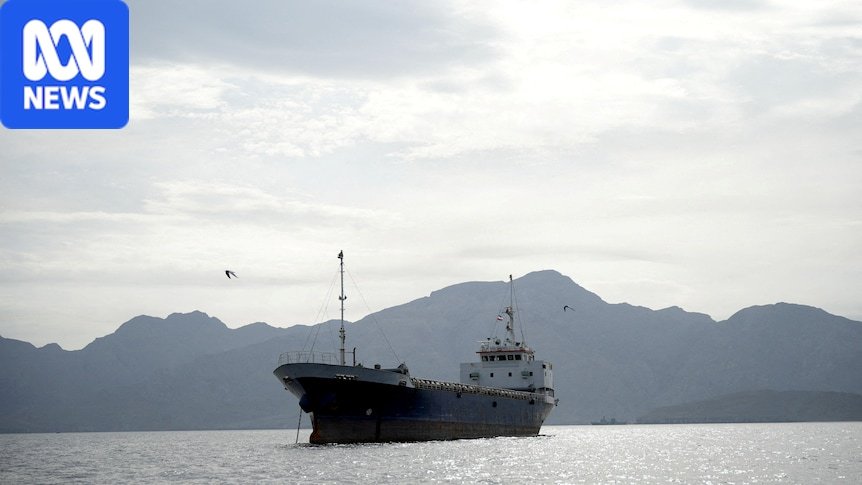
Iran has declared the Strait of Hormuz closed again after a Cyprus-flagged vessel used an “unauthorised route”. (Reuters)
According to CENTCOM, a crew member on the M/V GFS Galaxy, a Cyprus-flagged container ship, is missing, and the ship is stuck in the strait due to an onboard fire and significant engine room damage.
The United Kingdom Maritime Trade Operations (UKMTO) agency said authorities were investigating after the crew abandoned ship and were in a lifeboat.
“Iran was provided yet another opportunity to demonstrate adherence to the Memorandum of Understanding after being held accountable for earlier attacks on commercial vessels, but has again failed,” CENTCOM’s statement said.
“In response, the United States is imposing a heavy cost by continuing to degrade Iran’s ability to attack civilian mariners and commercial ships freely transiting the strait.“
Iran says strait closed, US bases attacked
Explosions were heard in the Iranian port cities of Bandar Abbas, Sirik and Chabahar, according to Iranian media, as well as on Qeshm Island, the largest island in the Persian Gulf and home to an underground Iranian missile base.
Iran earlier acknowledged the attack on the GFS Galaxy, saying it now considered the Strait of Hormuz to be closed “until further notice” after the ship travelled on an unapproved route, prompting the Revolutionary Guards to fire a “warning shot”.
“A vessel that had jeopardised maritime security by switching off its systems was struck and brought to a halt,” the Islamic Revolutionary Guard Corps navy said in a statement, adding that any retaliation would itself be met with a “severe response”.
Later CENTCOM said the Strait of Hormuz was open to all vessels seeking to lawfully transit and that US military forces were “positioned and prepared” to ensure freedom of navigation.
“Iran does not control the strait. Traffic is flowing,” it said in a statement.
The US Navy-led Joint Maritime Information Center reiterated guidance that, despite a severe security threat, an “expanded” southern route near Oman was available for two-way traffic.
Hours after the US attacks in Iran, the Revolutionary Guard said it had struck a second vessel in the strait.
It said it also launched ballistic missile strikes on the US military bases in Oman’s Port of Duqm, Kuwait and Jordan, including the Al Udeid air base in Qatar, claiming to have destroyed command and control centres and drone and refuelling facilities.
Kuwait’s military reported intercepting aerial targets in its airspace, while the UAE responded to missiles and drones from Iran.
Qatar said it had intercepted a missile attack as explosions were heard in Doha and sirens in Bahrain.
The US is demanding that Iran publicly state it will stop attacking ships in the Strait of Hormuz and commit to opening all of the waterway’s shipping lanes with no tolls, senior US officials said on Friday.
Iranian foreign minister meets Omani counterpart
Efforts to quell the renewed violence are underway on both sides, with a senior Iranian source telling Reuters that Iran, the US, Qatar and Pakistan had agreed to negotiate.
The negotiation was intended to take place in a call that mediators were trying to arrange for Saturday, while Iran’s Foreign Minister Abbas Araghchi was in Oman.
It was not immediately clear whether the efforts were successful.
Abbas Araghchi was in Oman on Saturday. (AP: Urs Flueeler)
Mr Araghchi did meet Omani Foreign Minister Sayyid Badr Albusaidi to exchange “views on appropriate mechanisms for the safe passage of ships through the Strait of Hormuz,” according to a statement from his office.
However, Oman’s state news agency later said that Omani and Iranian negotiators would continue talks “at the technical and political levels”, and no further announcements were made.
Oman is helping to mediate an end to the war that has destabilised the Persian Gulf and raised prices around the world since the US and Israel launched air strikes on Iran in February.
About one-fifth of the world’s oil supply transited through the Strait of Hormuz before the war, and Iran’s effective blockade of the waterway has caused energy prices to surge, fuelling global inflation.
US cable news outlet CNN reported on Saturday that Oman had proffered a draft proposal for the strait, including free navigation through its southern corridor in Omani territorial waters.
The plan called for vessels transiting the northern corridor through Iranian territorial waters to obtain prior approval from Iran, although no tolls would be imposed, CNN said.
The White House and State Department did not immediately respond to requests for comment on the CNN report.
New supreme leader vows revenge over father’s death
Mourners during the funeral ceremony for the late Iranian supreme leader Ayatollah Ali Khamenei on July 9. (AP: Office of the Iranian Supreme Leader)
Iran’s new supreme leader, still unseen since the war began, also vowed in his first statement since the funeral of his father, Ayatollah Ali Khamenei, that Iranians would avenge his killing in the war’s opening strikes.
Such revenge “is the will of our nation and must certainly be carried out,” Supreme Leader Mojtaba Khamenei said in a statement carried on state television.
The statement came just hours after Mr Trump threatened to “completely decimate and destroy all areas of Iran” should there be an assassination attempt against him.
US President Donald Trump and Secretary of Defense Pete Hegseth. (Reuters: Jonathan Ernst)
“1,000 missiles are locked and loaded and aimed at the Islamic Republic of Iran, with thousands of more to immediately follow, should the Iranian government act on its threat, pronounced in many corners of the Globe, to assassinate, or attempt to assassinate, the sitting President of the United States of America, in this case, ME!” Mr Trump wrote on Truth Social.
“Orders have already been given, and the US military is ready, willing and able, for a one-year period of time, subject to extension, to completely decimate and destroy all areas of Iran.”
He finished his post by saying “praise be to Allah”, a line he previously included on a post also threatening Iran earlier this year.
ABC/Wires
Source link